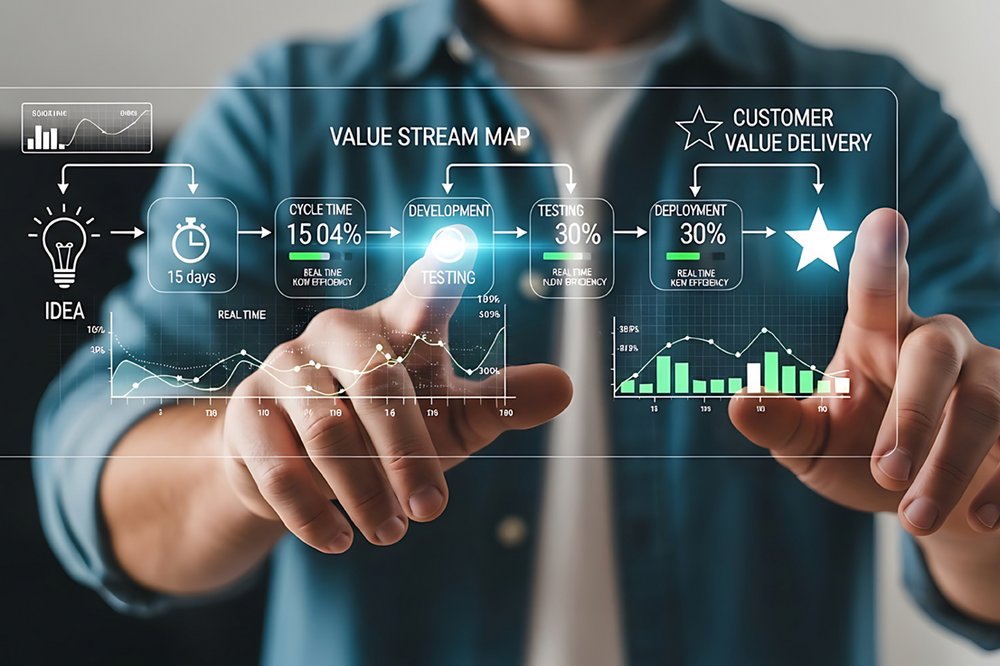
After initial agile pilot tests at the team level, the technology group introduced SAFe in a value stream in 2022 to test the framework internationally and specifically improve time-to-market.
The customer
After an initial attempt to introduce agility at the team level within the company, the technology group decided in 2022 to introduce the SAFe® agile scaling framework for a value stream. SAFe® was already in use in Japan, Australia, and the UK, thus offering the opportunity for global framework testing. This allowed experience to be gathered holistically on a worldwide scale. To this end, the technology group had invested in employees to manage the transition and conducted various in-house training courses—supported by KEGON—which gave a broader base the opportunity to see whether SAFe® offered a solution to time-to-market problems. The experiences gathered by the participants were consistently very positive.
The KEGON solution
Our services in the course of the following transformation included:
Phase 1
- Conducting assessments and experiments with accompanied coaching and further training beyond the delivery department. This was intended to reinforce the decision for such a massive change by the HR, sales, and marketing organizations.
- Basic training for all executives of the technology group in Germany, including both the management board and senior line management.
- Conducting a value stream analysis. Identification of 6 value streams. Derivation of a value stream for implementation according to SAFe®. Definition of KPIs such as flow time (lead time) and flow efficiency as a baseline for reviewing successful implementation.
- Identification of an initial Agile Release Train (ART) as a rollout pilot and derivation of the ART launch roadmap, definition of the setup of the agile teams for the start.
Phase 2
- Scaling the agile organization Setting up the transformation architecture
- Empowering the central transformation team, known as the Lean Agile Center of Excellence (LACE)
- Coaching LACE teams and managers on how to deal with change, psychological factors of transformation, and analysis, hypothesis formation, and measure development in the event of disruptions
- Anchoring a continuous learning culture and iterative improvement loops in the organization
- Developing conceptual foundations for a “product delivery organization” (the organization provides the customer with a continuous flow of valuable functions)
- Developing conceptual foundations for cross-functional team structure
- Workshops and training courses on agile leadership, lean portfolio management, and the role of business owners
- Pilot 1st ART launch with a focus on cross-functional collaboration and participation of all company divisions Empowerment of ART-specific roles through training and coaching on the job
- Implementation of training courses on agile fundamentals and agile leadership
- Implementation of role-specific training and coaching (especially Scrum Master and Product Owner)
- Conducting retrospectives, inspect & adapt workshops, and problem-solving workshops
- On-the-job coaching for agile roles with a focus on Scrum Masters and Product Owners
- Coaching agile teams and strengthening the mindset for agile working methods
Phase 3
- Updating the transformation roadmap, prioritizing change projects, making disruptions within the organization visible
- Launching additional ARTs: Empowering internal agile roles for the sustainable, continuous development of the organization
- Continuous implementation of value stream mapping to optimize flow time, improve collaboration, and reduce interfaces within and outside the Agile Release Train.
- Conducting team building workshops and using the results from the value stream mapping workshops to optimally mix the composition of the cross-functional ART teams.
- Training and supporting roles and teams
- Synchronizing the ART teams with the interacting teams outside the ART.
- Supporting the transformation team
- Supporting communication
- Weekly active exchange in ART Sync, Scrum Master Sync, and PO Sync meetings to promote and ensure communication between the ART teams
- Weekly info session for all ART members
- Holding “consultation hours” on various topics (e.g., use of JIRA, general questions about SCRUM and agile working)
- Integration of works council members within the ART
- Conducting quarterly PI planning sessions. All ART members and relevant stakeholders are present at these sessions. This brings everyone involved together and creates a very good common understanding of the planned work packages
- Implementing a control process using metrics and initiating continuous improvement
- Supporting communication
- Supporting the organization in tackling further areas of action (e.g., cooperation with sales, implementation of a portfolio process, anchoring lean-agile leadership)
- Supporting the implementation of an agile organizational structure (e.g., creation of a new Service & Transformation department with the development and establishment of new agile roles and functions)
Results
An initial experiment with a cross-functional agile team was very successful and managed to implement a critical issue for the company. This enabled the launch of an Agile Release Train with approximately 60 members. The train was regularly optimized and successfully implemented the planned topics, strengthening the area in the agile transformation.
Successful proof that agile working significantly optimizes collaboration and can significantly improve lead time in a Scrum team and in an entire train (by a factor of 4 in the team and by a factor of 5 in the train).
Would you like more information or do you have any questions?
Feel free to contact us!
Irina Heck
Tel +49 611 20 50 80
irina.heck(at)kegon.de


