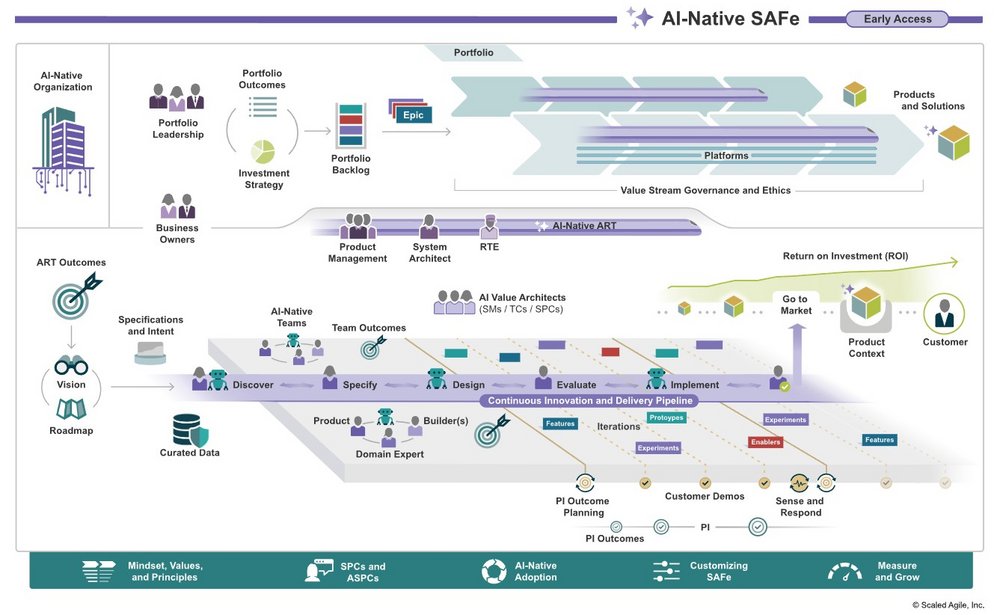
With the new version of the Scaled Agile Framework introduced on June 16, 2026, Scaled Agile is taking a decisive step into the future of organizational development: SAFe® is evolving into AI-Native SAFe®.
At the core lies a key question many organizations are currently facing:
How will artificial intelligence and AI agents reshape the way we build products and design organizations?
From Tool to Foundation
The answer is clear: AI is no longer seen as a tool that merely accelerates existing processes. Instead, AI-Native SAFe® describes an organization designed from the ground up for collaboration between humans and AI agents.
This marks a fundamental shift—from “AI as an add-on” to “AI as an integral part of value creation.”
Key Changes at a Glance
AI-Native SAFe® introduces several significant changes:
Smaller Teams
Development teams will often consist of just three to five people, supported by AI agents. Roles will evolve, responsibilities will shift, and human–AI collaboration will become a defining factor.
More Focused Agile Release Trains (ARTs)
With increased productivity at the team level, ARTs will become smaller, more focused, and more efficient.
Shorter Planning Cycles
Planning will move away from long time horizons toward much shorter cycles. Instead of weeks or months, planning may take place in days or just a few weeks. Traditional PI Planning is evolving into Outcome Planning.
Outcome over Output
As AI enables scalable development capacity, the volume of produced artifacts becomes less relevant. What truly matters is the real impact delivered to customers and the market.
Continuous Innovation instead of Continuous Delivery only
The focus shifts from fast feature delivery to continuously generating and validating innovation.
Between Vision and Reality
Many of these concepts still feel visionary. At the same time, they point toward a direction that many organizations are already beginning to explore:
- How will teams and roles evolve?
- What does leadership look like in an AI-native environment?
- How must planning and governance adapt?
- And how can AI be meaningfully integrated into value creation?
Our Perspective at KEGON
At KEGON, we are closely observing these developments. We are particularly interested in understanding which of these concepts will prove effective in practice and what organizations need to truly become AI-native.
Because one thing is clear: transformation will not happen through frameworks alone, but through real organizational change.
Looking ahead
The key question remains: Will we actually work in teams of three to five people in just a few years, with planning cycles measured in days?
AI-Native SAFe® provides a strong direction—the real implementation now lies in the hands of organizations.
All AI-Native SAFe® trainings are listed at KEGON Academy.


